How to Create a Nature Play Yard in Your Backyard (That Kids Actually Use)
This post contains affiliate links. I may earn a small commission at no extra cost to you.
If I had a dollar for every time one of my kids walked past the swing set and went straight for the dirt pile, I could fund our entire homeschool year. Twice.
Here’s the thing — kids don’t actually need elaborate, expensive outdoor equipment. What they need is permission and a little setup. A space that says, “Yes, you can dig here. Yes, you can get muddy. Yes, that bug is worth investigating.” That’s a nature play yard. And once you create one, you’ll be amazed at how many hours your kids will disappear into it without a single complaint of “I’m bored.”
We’ve been slowly building ours here in Pensacola over the last couple of years, and honestly, it’s become one of the best things we’ve done for our kids’ childhood. It feeds right into our Charlotte Mason approach — living education, real observation, hands-on everything. Let me show you what we did and how you can do it too, no matter what size backyard you’re working with.
What Is a Nature Play Yard (And Why Does It Matter)?
A nature play yard is basically a section of your backyard that’s been intentionally set up to encourage open-ended, child-led outdoor play using natural materials. Think loose parts — logs, rocks, sand, water, dirt, sticks. Think sensory experiences, not plastic slides.
This isn’t a new idea. This is just what backyards used to look like before we started buying so much stuff. The 1990s version of every backyard had a pile of something — gravel, mulch, dirt — and kids just figured it out from there. We’re just being a little more intentional about it now.
The research backs it up too: unstructured outdoor play builds creativity, problem-solving, physical confidence, and emotional regulation. But honestly, I didn’t need a study to tell me that. I just needed to watch my kids spend three hours building a dam in the mud after a Florida afternoon thunderstorm.
Step 1: Start With a Zone, Not a Full Overhaul
You don’t have to redo your entire yard. Pick a corner or a patch — even a 10×10 area works — and designate it as the nature play zone. Somewhere with a little shade is ideal, especially here in Northwest Florida where the summer sun is absolutely relentless by 10 a.m.
If you have trees, even better. Natural shade, sticks to collect, and bark to investigate. If not, a shade sail or simple pergola works.
Tell your kids this spot is theirs. That alone changes everything.
Step 2: Add a Mud Kitchen or Dig Pit
This is the heart of any good nature play yard, and it genuinely costs almost nothing to set up.
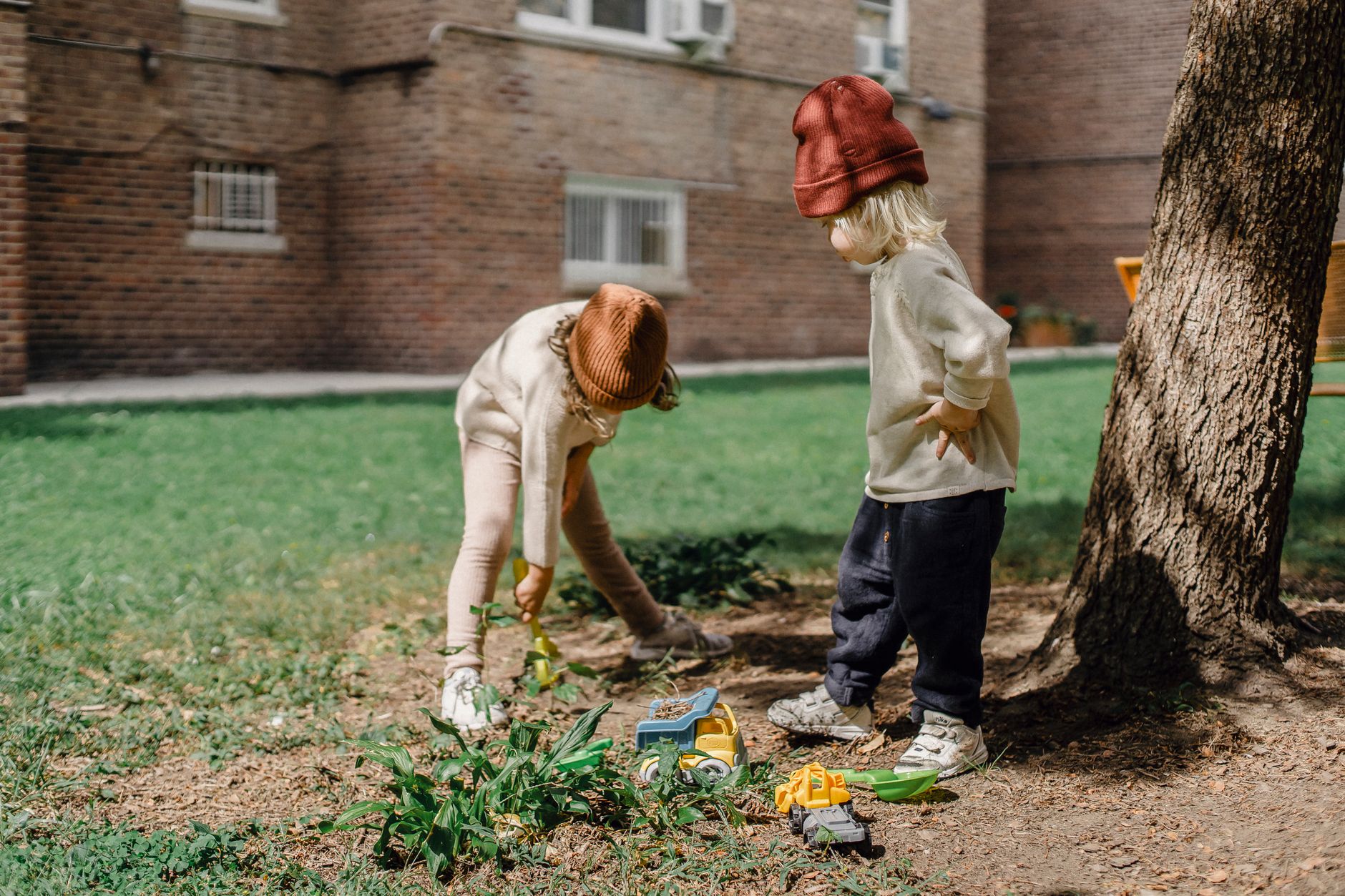
For a dig pit: Loosen up a section of ground, or fill a raised bed or old sandbox frame with a mix of soil and sand. Let kids dig freely. Bury “treasures” — rocks, shells, pinecones — for them to find.
For a mud kitchen: Grab some old pots and pans from a thrift store, a water source nearby (a simple spigot or even a big bucket), and you’re done. My kids have spent entire mornings making “soup” out of mud, Spanish moss, and whatever the chickens left behind. It’s glorious.
This kind of messy, sensory play is genuinely irreplaceable. Let it happen. That’s what kids rain boots were made for.
Step 3: Create a Bug and Nature Discovery Station
This is where our Charlotte Mason roots really show up in the yard. We set up a small table or stump near the dig pit where the kids can bring their finds and actually look at them.
We keep a few things out there permanently:
- A pocket microscope that has genuinely blown my kids’ minds (ant legs under magnification = instant science lesson)
- A bug collection kit with containers and a magnifier
- A worn copy of the Sibley Birds guide because Florida birds are everywhere and worth knowing
- A nature journal for sketching finds — this is such a simple habit and it builds real observation skills over time
We live in Florida, so there is absolutely no shortage of things to discover. Anoles, lubber grasshoppers, Gulf fritillary butterflies, walking sticks — the biodiversity here is wild and we treat it like the living classroom it is.
If you want some good read-alouds to pair with your outdoor exploration time, I shared some favorites in this post: Best Picture Books for Nature-Loving Kids (Our Favorite Read-Alouds for Little Explorers)
Step 4: Bring In Loose Parts
Loose parts are the magic ingredient. These are open-ended natural materials that kids can move, combine, stack, sort, and use however their imagination leads them. No instructions. No right answer.
Some of our favorites that we’ve collected or sourced cheaply:
- Large river rocks and smaller pebbles
- Pinecones and acorns (abundant in Northwest Florida)
- Sections of cut logs in varying heights (our chickens love these too — perches everywhere)
- Bamboo lengths or thick sticks
- Shells from local beaches
- Pieces of natural rope or twine
If you want more ideas for outdoor play that doesn’t require buying anything fancy, check out Outdoor Play Ideas for Kids with No Equipment Needed (Just Fresh Air and a Little Imagination) — it’s full of exactly that.
Step 5: Add a Garden Corner Kids Can Own
Even a small raised bed or a few containers gives kids real responsibility and a front-row seat to how food grows. We let our kids pick what goes in their corner each season, and they’re far more invested in tending it when it’s theirs.
A seed starting kit is a great way to start seeds together inside before transplanting. Grab some kids garden gloves so they actually want to dig in — my kids weirdly love having their own pair.
If you want to get into composting with them (which connects beautifully to the garden), we have a whole beginner’s guide here: Composting at Home with Kids: A Real Beginner’s Guide That Actually Gets Done
Step 6: If You Have Chickens, Let the Kids Help Tend Them
Okay, I know not everyone has backyard chickens — but if you do, your flock is already one of the best “nature play” features in your yard. Our kids collect eggs, fill the chicken waterer, scatter scratch, and watch the hens do their thing. It teaches responsibility, animal behavior, and life cycles in the most natural way possible.
If you’re new to chickens or thinking about starting a flock, the Storey’s Guide to Raising Chickens is what we started with, and the Kid’s Guide to Keeping Chickens is genuinely a great one for your elementary-age kids to have their own copy.
Step 7: Keep It Wild (Resist the Urge to Over-Tidy)
This one is for us mamas as much as for the kids. A nature play yard is supposed to look a little wild. Sticks in piles. Mud tracked somewhere. A collection of rocks on a stump.
Fight the urge to tidy it all up every day. Let the kids leave their work-in-progress. The stick fort they abandoned on Tuesday might be where they pick up again on Friday — but only if it’s still there.
The beauty of raising kids this way — less curated, more alive — is that they learn to entertain themselves deeply. They build attention spans. They work through frustration. They create. That’s the whole point.
A Few Safety Notes for Florida Yards
We’re in Florida, so a quick word: check for fire ants regularly, especially in dig pits and around loose logs. We use food grade diatomaceous earth around the perimeter of the yard and near the coop — it’s safe for kids and pets when used correctly. And slather on that non-toxic sunscreen before heading out — the Florida sun doesn’t play.
Creating a nature play yard doesn’t require a big budget, a big yard, or a big plan. It just requires saying yes — yes to dirt, yes to bugs, yes to the kind of childhood that builds real kids. Our backyard isn’t Pinterest-perfect. There are mismatched containers, a perpetually muddy patch near the hose, and a log pile that has somehow become both a fort and a chicken perch. And I wouldn’t change a single thing about it.
Start with one corner. Add a stick and a rock. Watch what happens.
📖 You Might Also Like:
- Morning Basket Ideas for Charlotte Mason Homeschool (What Ours Actually Looks Like)
- Best Egg Laying Chickens for Florida Heat (What Actually Works in Our Backyard Flock)
- Rainwater Harvesting in Florida: What’s Legal, What Works, and How to Set It Up
Frequently Asked Questions
What is a nature play yard?
A nature play yard is a section of your backyard intentionally designed for open-ended, child-led outdoor play using natural materials like dirt, sand, rocks, sticks, and water. It prioritizes sensory exploration and free play over structured or equipment-based activities.
How do I create a nature play yard on a budget?
You don’t need to spend much at all. Start by designating a corner of your yard and loosening the soil for a dig pit. Add thrifted pots and pans for a mud kitchen, collect rocks, pinecones, and sticks as loose parts, and grab an inexpensive bug catcher or pocket microscope. Most of the best elements are free or nearly free.
What age is a nature play yard good for?
Nature play yards work beautifully for kids from toddlers through elementary age (roughly 2–10 years old), though older kids often love them too when given the right loose parts and challenges. The open-ended nature of the space means it grows with your kids as their interests evolve.
Is a nature play yard safe for young kids?
Yes, with a few common-sense precautions. Supervise toddlers around water features, check for fire ants or stinging insects regularly (especially important in Florida), apply non-toxic sunscreen before outdoor time, and avoid using chemically treated wood or mulch in areas where kids dig and play.
What should I put in a nature play yard for a small backyard?
Even a small space can hold a lot of nature play potential. Focus on vertical and contained elements: a small raised bed garden, a container mud kitchen, a stump or two for climbing and displaying nature finds, a bug discovery station with a magnifier, and a bucket of loose parts like rocks and shells. You don’t need much square footage — just intentional setup.
Leave a Reply