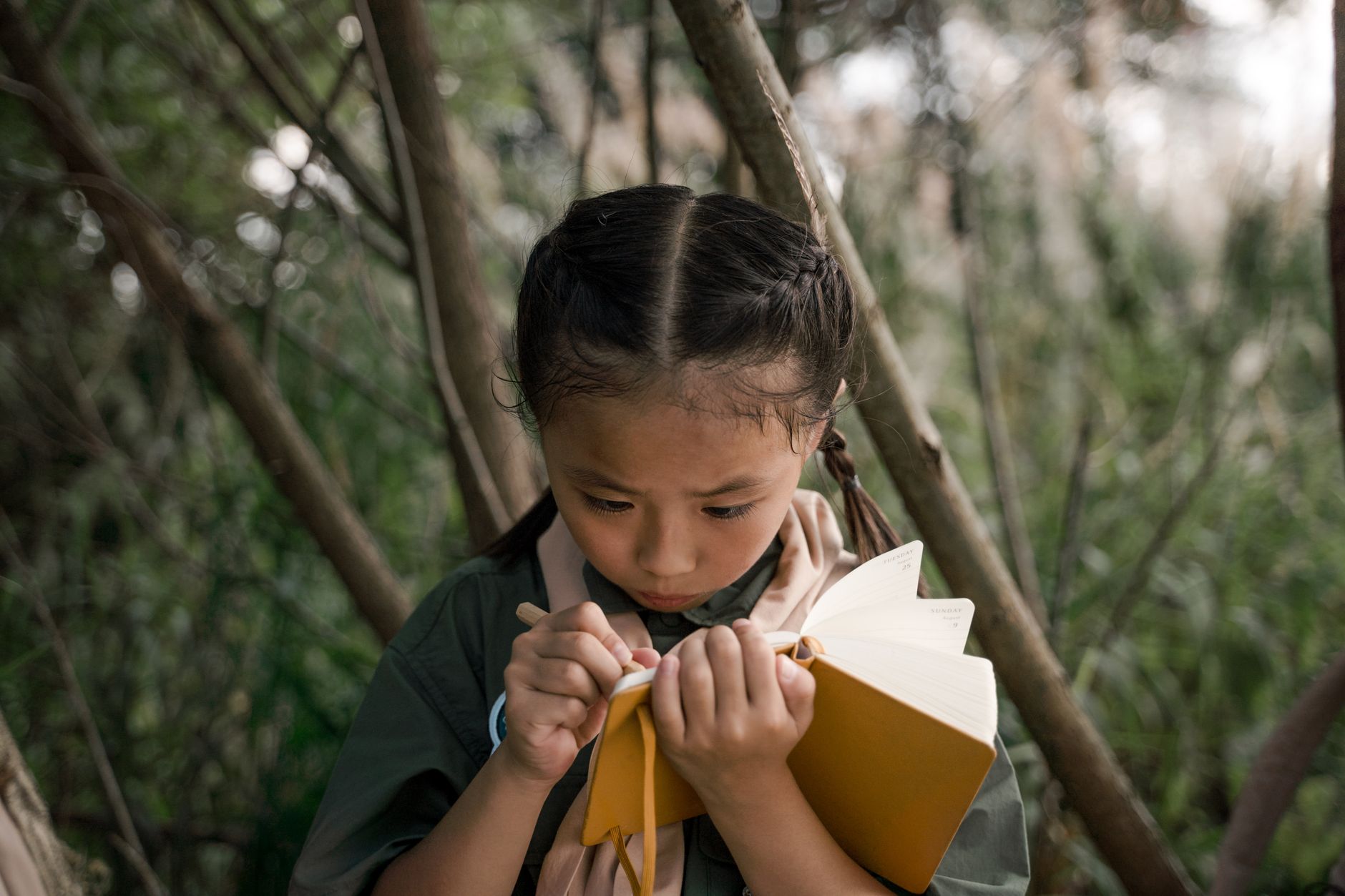
Charlotte Mason Nature Study Journal Prompts by Season (For Real Kids Who’d Rather Be Outside)
This post contains affiliate links. I may earn a small commission at no extra cost to you.
Here’s what nature journaling looked like in our house about a year ago: I handed my kids a blank notebook, said “draw something from outside,” and got two blank stares and one meltdown.
Turns out, “go observe nature” is a little too open-ended when you’re seven. Who knew.
What actually worked? Giving them a specific thing to look for. A question to answer. A tiny mission. That’s when the pages started filling up — and honestly, that’s when I started looking forward to it too.
If you’re doing a Charlotte Mason or nature-based homeschool and you’ve been wondering how to make nature journaling feel less like pulling teeth and more like something your kids actually ask to do, this is for you. I’m sharing the prompts we rotate through by season — adapted for Florida, because yes, we do have seasons down here. They’re just… subtle.
First, a Word About Supplies (Keep It Simple)
You don’t need anything fancy to start. Truly. We use a dedicated nature journal for each kid — it has blank pages which works way better than lined for sketching — and a set of Faber-Castell watercolors that have held up for years. A pencil, an eraser, and a magnifying glass or pocket microscope round it out nicely.
For bird ID (because birds come up in every season), we keep the Sibley Birds guide on the shelf and grab it constantly. My older kids have started using it independently, which is one of those small homeschool wins that feels enormous.
Okay. Prompts. Let’s go.
Fall Nature Journal Prompts (October–November in Florida)
Fall in Northwest Florida is glorious — the humidity finally breaks, the light turns golden, and the kids practically live outside again after surviving August. This is prime nature journaling season for us.
Prompts to try:
- Draw and label one tree you can see from the backyard. Is it losing leaves or staying green?
- Find a seed pod or acorn. Sketch it from two angles — top and side.
- Watch the bird feeder for 10 minutes. List every bird you see. Can you identify any using a field guide?
- What does the air smell like today compared to summer? Write three describing words.
- Find something that’s decomposing (a leaf, a stick, a piece of fruit). Draw it and describe what you think is happening to it.
- Where do you think the butterflies go when it gets cold? Write your best guess.
Fall is also when we start seeing more bird migration activity in our yard and down at the bay. If your kids have caught the bird bug, check out our post on Charlotte Mason Picture Study — the same slow-looking skills transfer beautifully to bird observation.
Winter Nature Journal Prompts (December–February)
Winter here is mild and genuinely lovely. We get maybe a handful of cold snaps, some frost if we’re lucky (or unlucky, depending on the garden situation), and the kids are outside most days in a light jacket. The garden slows, but there’s actually so much to observe.
Prompts to try:
- Sketch the bare branches of a tree. How do the branches get smaller as they go out?
- Find evidence that an animal was here — tracks, chewed bark, a feather, droppings. Draw what you found.
- Check on the chickens. How are they behaving differently in the cold? (Ours huddle more and slow down on laying.)
- Measure and record the temperature at 8am, noon, and 4pm for three days. Do you notice a pattern?
- Draw a cloud. Look up what type it is and label it.
- Find something that’s still alive and green. Why do you think it survived the cold when other plants didn’t?
Winter is honestly one of the best seasons for quiet, slow observation — the frantic growing and buzzing of summer calms way down and kids can actually focus on one thing at a time.
Spring Nature Journal Prompts (March–April)
Spring in Florida hits fast and it hits hard. One week the yard looks dormant and then suddenly everything is exploding — new growth, insects, baby birds, the whole show. This is the busiest journaling season at our house.
Prompts to try:
- Find a flower and draw every part you can see. Look up the parts (petal, stamen, pistil) and label them.
- Catch an insect (carefully!) and observe it for two minutes before releasing. Draw it and describe how it moves. A bug collection kit makes this so much easier and more humane.
- Watch an ant trail for five minutes. Where are they going? What are they carrying?
- Find a spider web — sketch it and try to figure out what kind of spider made it.
- Plant one seed today. Sketch the seed before planting, then check and draw it every 3 days as it sprouts.
- What new sounds do you hear outside today that you didn’t hear in January?
Spring is also when our chickens ramp back up on egg production and the kids get really interested in the whole cycle of life again. We use those moments — a hen sitting on eggs, a chick hatching — as living science. If you want a great resource your kids can read themselves, the kid’s guide to chickens is wonderful for this age.
Summer Nature Journal Prompts (May–September in Florida)
Okay, real talk: summer in Pensacola is no joke. By 10am it’s brutal, and by July we’re doing nature journaling in 15-minute bursts at 7:30am before the heat wins. But there is SO much to observe if you get out early.
Prompts to try:
- Sketch the sky at sunrise. What colors do you see? What shapes are the clouds?
- Find something that’s adapted to survive the heat. How do you think it does it?
- Collect three different types of leaves from the yard. Press them and trace their shapes. Notice the veins — are they the same?
- Watch a puddle after a summer rainstorm. What comes to drink from it? What insects appear?
- Lie in the grass (early morning only — fire ants!) and look up. Draw exactly what you see from that angle.
- Track a thunderstorm: what time did it start? How long did it last? Which direction did it move?
Summer is also prime time for the kind of 1990s-style unstructured outdoor time that our family is really intentional about protecting. We write about that in detail over at Raising Kids Without Screens: What We Actually Do Every Day — the nature journal is honestly one of our biggest tools for making that happen without kids complaining of boredom five minutes in.
Tips for Making Nature Journaling Stick
Keep it short. Fifteen focused minutes beats an hour of resistance every single time. We do nature time before our morning lessons, and the journal comes with us — it’s not optional, but it’s also not a production.
Don’t correct the art. A seven-year-old’s caterpillar looks like a lumpy snake. That’s fine. The goal is observation, not illustration. Charlotte Mason was clear on this — we’re training the eye, not the hand.
Let them pick the subject sometimes. The prompts are a starting point. If your kid is obsessed with the garden spider that moved into the tomato cage, let them journal that spider for two weeks straight. Deep noticing of one thing is more valuable than shallow skimming of many.
Make it cozy. A clipboard, their journal, their own set of watercolors, and a stainless steel water bottle they actually like carrying — small things make it feel like theirs.
One Last Thing
Nature journaling isn’t about producing beautiful pages. It’s about teaching your kids to slow down and actually see the world they’re standing in. In a time when everything is fast and loud and digital, sitting outside with a pencil and paying attention to a beetle for ten minutes is genuinely countercultural.
And that’s exactly why we do it.
I hope these prompts give your family a jumping-off point — and I’d love to hear what your kids end up noticing. Some of my favorite moments from the past year have come from my kids pointing out something I walked past a hundred times without seeing. That’s the whole point, really.
Happy journaling, friends. Go get some dirt on your hands.
📖 You Might Also Like:
- Florida Homeschool Special Needs Resources and Support (What Actually Helps Real Families)
- Rainwater Harvesting in Florida: What’s Actually Legal and How to Set It Up
- Florida Homeschool Testing Requirements: Evaluation vs Portfolio (What You Actually Need to Know)
Frequently Asked Questions
What should a Charlotte Mason nature journal include?
A Charlotte Mason nature journal typically includes hand-drawn sketches of plants, animals, insects, and other natural objects, along with written observations, dates, weather notes, and sometimes watercolor illustrations. The focus is on careful, firsthand observation rather than copying from books or producing perfect artwork. Blank or lightly lined pages work best so kids have freedom to sketch and write however feels natural.
How often should we do nature journaling with a Charlotte Mason approach?
Charlotte Mason recommended getting outside daily, but formal nature journaling a few times a week is very realistic for most homeschool families. Even 15–20 minutes of intentional outdoor observation with sketching and writing is enough to build the habit and skills over time. Consistency matters more than duration — short and regular beats long and occasional.
What age can kids start a nature journal?
Kids can start nature journaling as young as 4–5 years old, though at that age it looks more like dictating observations to a parent who writes them down, or making simple scribble drawings. By around age 6–7 most kids can independently sketch and write a sentence or two. The prompts in this post are geared toward elementary-age kids, roughly K–5th grade.
How do you do Charlotte Mason nature study in Florida when the seasons aren’t obvious?
Florida definitely has seasons — they’re just defined by rainfall, humidity, temperature swings, and the creatures and plants that respond to those changes rather than dramatic leaf color or snow. Fall and winter in North Florida especially offer noticeably different light, temperatures, and bird activity. The key is tuning kids into *local* seasonal cues: when do the oak catkins drop? When do the monarchs pass through? When does the garden go dormant? Florida nature journaling can be incredibly rich once you stop waiting for fall leaves and start observing what’s actually changing.
Do nature journal pages count toward Florida homeschool portfolio requirements?
Yes — nature journal pages can absolutely be included in a Florida homeschool portfolio. They demonstrate science observation skills, writing, illustration, and critical thinking across multiple subjects. If you’re using the Florida PEP scholarship or maintaining a portfolio for your umbrella school or evaluator, nature journals are a great way to document hands-on learning in a tangible, meaningful way. Always check with your specific evaluator or umbrella school for their preferences on how portfolio materials should be presented.
Leave a Reply