Homeschool Socialization: How We Actually Handle It (And Why I’ve Stopped Defending Myself)
This post contains affiliate links. I may earn a small commission at no extra cost to you.
If I had a dollar for every time someone asked me, “But what about socialization?” — usually with that slightly-concerned head tilt — I could fund our curriculum for the next three years.
I get it. It’s the question. The one every homeschool family braces for at Thanksgiving or in the grocery store checkout line. And for a while, I felt this pressure to defend our choice, to rattle off a list of co-ops and activities like I was presenting evidence in a court case.
But here’s where I’ve landed after a few years of doing this: our kids are more socially competent than I expected, not less. And the way we’ve built that has been intentional — not accidental, not defensive, just thoughtful.
So let me just walk you through what it actually looks like for our family.
First, Let’s Reframe What “Socialization” Even Means
When most people ask about socialization, what they’re picturing is a cafeteria full of kids the same age, navigating peer dynamics for six hours a day. And I don’t say that to be dismissive — that is one kind of social experience.
But is it the only kind? Or even the best kind?
Think about how we actually function as adults. We talk to our neighbors, our coworkers of all ages, the elderly woman at church, the teenager bagging our groceries. Real-world socialization is multi-age, multi-context, and deeply relational — and that’s exactly what homeschool life tends to naturally produce.
Our kids talk to adults without melting. They play with kids younger than them without rolling their eyes. They’ve learned to carry on a real conversation. Some of that comes from homeschooling. Some of it comes from being raised in an environment that looks a lot like how kids grew up in the 1990s — with more free time, more mixed-age play, and more room to figure things out.
How We Actually Build Community Day to Day
Our Homeschool Co-op
This is probably the biggest structured piece for us. We’re part of a small co-op in the Pensacola area that meets weekly. The kids rotate through classes taught by different parents, do projects together, eat lunch together, and basically just hang out. It scratches the “group learning” itch while keeping things a lot more flexible and relationship-based than a traditional classroom.
If you’re new to homeschooling in Northwest Florida, I’d genuinely encourage you to search for local co-ops through your church, Facebook groups, or even the Florida PEP scholarship networks. There are more families doing this than you’d think, and community is out there — it just takes a little hunting.
Nature Study and Outdoor Time Together
We do a lot of our learning outside, and that naturally creates connection. When we go on a nature walk, neighbor kids often tag along. When we’re studying birds with our Sibley Birds guide or doing a sketching session in our nature journals, it’s not unusual to have a few extra kids sitting on our back porch joining in.
Nature study is one of those things that draws kids together in a really organic way. Nobody’s performing or competing — everybody’s just watching the same anole lizard or poking the same ant mound with a stick. It levels the playing field. If you’re looking for a fun starting point for outdoor exploration, our free Florida nature scavenger hunt printable is a great way to get a group of kids moving and noticing together.
The Chickens Are Basically Social Magnets
I’m only half joking. Our backyard chickens have become the neighborhood gathering point. Kids from three houses down show up regularly to help collect eggs or just watch the flock do their chaotic chicken thing. It opens up conversations about responsibility, animal care, and where food comes from — and it gives our kids something real and interesting to share with other kids.
If you’re thinking about starting a small backyard flock, Storey’s Guide to Raising Chickens is where I’d start. There’s also a great kid-friendly chicken guide that my kids have actually read themselves.
Structured Activities Outside the Home
Beyond co-op and neighborhood life, our kids are involved in a handful of things that put them consistently with peers:
- Church and Sunday school — This is huge for us. It’s consistent, it’s community-rooted, and it builds friendships that go beyond just shared curriculum.
- Sports and classes — Swimming lessons, a youth nature program through one of our local parks, and whatever seasonal sport they’re currently obsessed with.
- Library programs — Escambia County’s library system has solid kids’ programming, and it’s a surprisingly great place for homeschool kids to connect.
The key word is consistent. Dropping in on random activities doesn’t build friendships. Showing up week after week to the same place with the same people — that’s where real relationships form. We try to choose a few things and commit to them rather than spreading thin across a dozen activities.
What I Tell People When They Ask
Honestly? I’ve stopped giving the defensive answer. Now I just say something like, “They’ve got more social time than you’d think — it just looks different.”
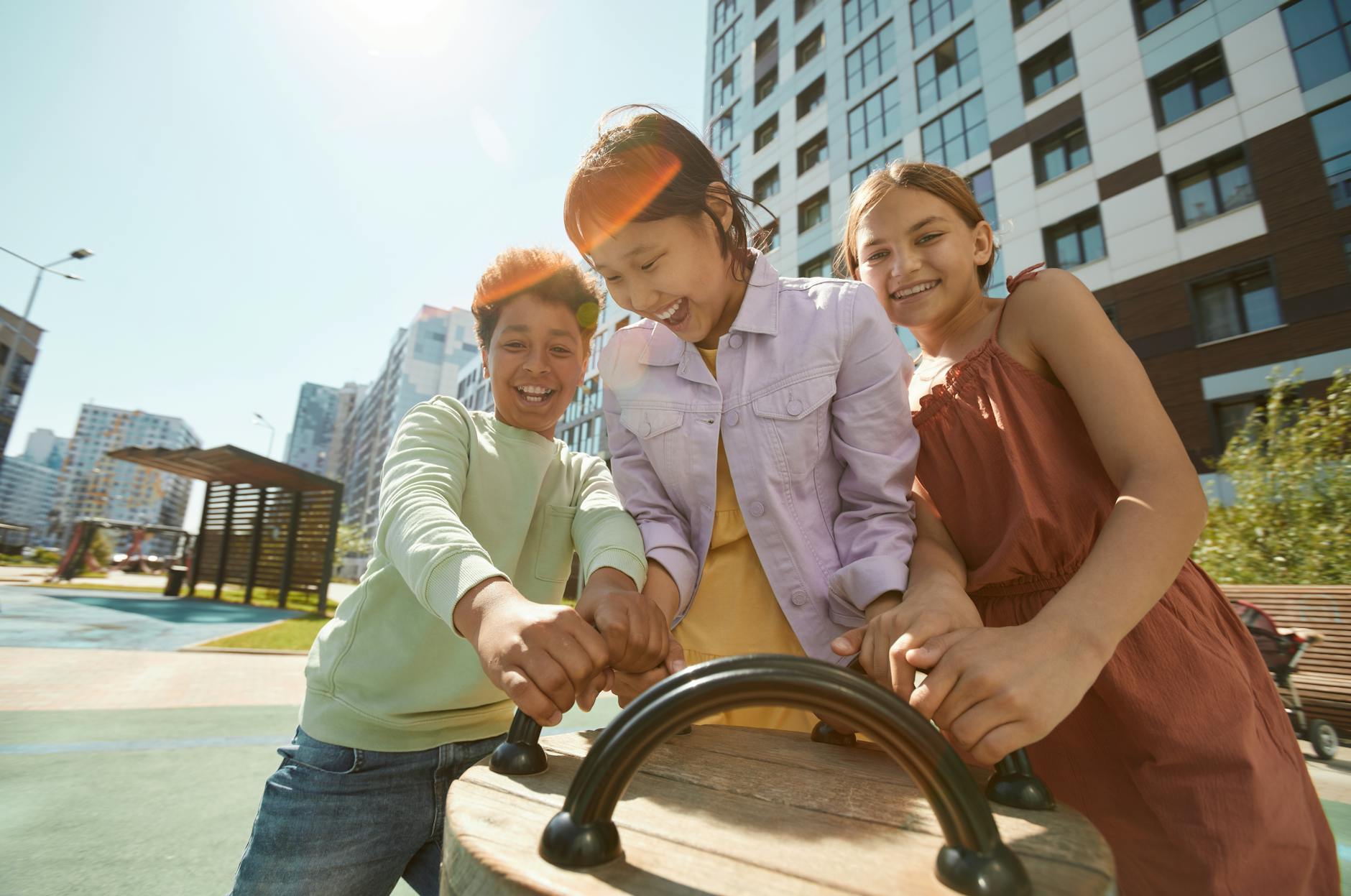
Because it does. My kids aren’t isolated. They’re building friendships through shared experiences — feeding chickens, catching bugs with a bug collection kit, running around the yard with walkie talkies, playing lawn games until someone’s sun-tired and ready for the porch. That is childhood. That is social development. It’s just not happening inside a cinderblock building.
If you want to dig deeper into the philosophy behind raising kids with more freedom and less structured supervision, I wrote about that in How to Raise Free-Range Kids in the Modern World — it’s one of my favorite posts on this whole site.
The Honest Part: It Does Take Intentionality
I want to be real with you here, because I think the homeschool world sometimes overcorrects and pretends like socialization just magically works itself out.
It takes effort. You have to build the community because it won’t just show up at your door. There were seasons — especially when we were newer to homeschooling — where I had to push myself to seek out connections even when it felt awkward or like too much to add to our plate. There were also seasons where I over-scheduled us trying to prove something, and that’s its own kind of burnout. If you’ve been there, you might recognize yourself in my post about homeschool burnout and how to actually recover from it.
The sweet spot we’ve found is: a few consistent commitments, lots of unstructured outdoor time, an open-door policy for neighborhood kids, and a community of families who are doing life similarly to us.
That’s it. That’s the whole strategy.
You Don’t Have to Justify Your Choice
If you’re a newer homeschool family reading this and you’re still in the phase of feeling like you need to defend how your kids will “turn out” — I just want to say: you can let that go.
Watch your kids. Watch how they interact with the mail carrier, with your elderly neighbor, with the five-year-old at the park. If they’re kind, curious, and able to hold a conversation — they’re doing just fine.
That’s what we’re raising. Not kids who survived a particular institution. Kids who know how to show up in the world.
And most days, around here, that starts with going outside.
📖 You Might Also Like:
- Free Florida Nature Scavenger Hunt Printable for Kids (Charlotte Mason-Friendly and Actually Fun)
- How to Raise Free-Range Kids in the Modern World (A Real Family’s Guide)
- 1990s Childhood Activities We’re Bringing Back (And Why Our Kids Are Thriving Because of It)
Frequently Asked Questions
Do homeschool kids struggle socially?
Most research and real-world experience suggest that homeschool kids are not socially behind — and many are actually more comfortable interacting with people of different ages than their traditionally-schooled peers. The key is that socialization has to be intentional. When families invest in co-ops, community activities, church, sports, and plenty of unstructured outdoor play with neighborhood kids, homeschool children develop strong relational skills. The difference is the environment looks less like a school hallway and more like real life.
How do homeschool kids make friends?
Homeschool kids make friends through co-ops, church, sports teams, library programs, neighborhood play, and community classes. Many homeschool families also connect through local homeschool networks and social media groups — especially in areas like Northwest Florida where the homeschool community is active. The friendships that form tend to be multi-age and built around shared interests rather than just shared grade level, which actually mirrors how adult friendships work.
Is homeschool socialization a real concern?
It’s a legitimate question, but it’s often based on the assumption that school-based socialization is the gold standard. In reality, six hours a day with same-age peers in a structured institution is just one model of social development — not necessarily the best one. Homeschool families who are intentional about building community, pursuing activities outside the home, and fostering neighborhood and church relationships typically raise socially confident, capable kids.
How do I find a homeschool co-op in Florida?
In Florida, a great starting point is searching local Facebook groups with terms like ‘[your city] homeschool co-op’ or connecting through your church or library. Many co-ops are also connected to the Florida PEP scholarship network. The FPEA (Florida Parent-Educators Association) is another resource for finding local homeschool groups, events, and support. Don’t be discouraged if the first group isn’t the right fit — the community is out there.
What does Charlotte Mason say about socialization?
Charlotte Mason’s philosophy actually emphasizes living relationships as essential to education. She believed children should have access to the real world — nature, community, service, literature, and meaningful conversation with people of all ages — rather than being confined to an age-segregated classroom. A Charlotte Mason homeschool approach naturally builds social connection through nature study groups, collaborative projects, narration (which builds communication skills), and time in the broader community.
Leave a Reply