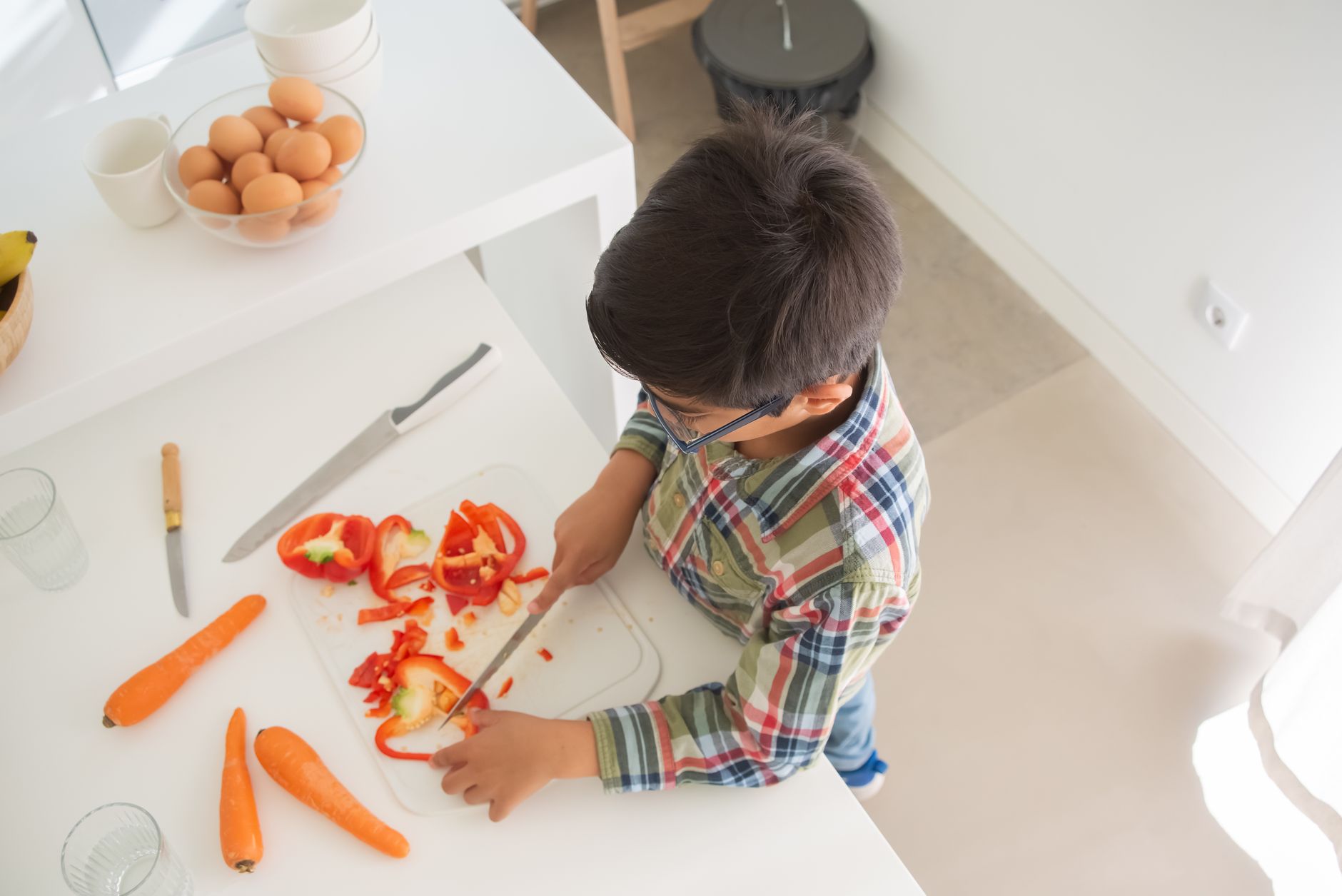
How to Teach Kids to Cook Basic Skills by Age (Without Losing Your Mind or Your Kitchen)
This post contains affiliate links. I may earn a small commission at no extra cost to you.
Somewhere along the way, we stopped teaching kids how to feed themselves. I don’t mean snacks out of a bag — I mean actually cook. Crack an egg. Stir a pot. Know what it smells like when butter is about to burn. My grandmother could make biscuits from scratch at nine years old. My mom could debone a chicken by middle school. And here we are, handing our kids a tablet and telling them dinner’s ready.
I’m not here to be preachy about it — because honestly, I had to work at this too. Getting kids into the kitchen is chaotic. It takes longer. Things get spilled. But somewhere between the flour cloud and the scrambled eggs that are a little too brown, something real is happening. They’re learning to feed people they love. And that matters.
We’ve been weaving cooking into our homeschool days for years now, and it fits naturally into our Charlotte Mason approach — real life is the curriculum. The kitchen is just another classroom.
Why the Kitchen Is One of the Best Places to Homeschool
Seriously. Before we even get into the age-by-age breakdown, I want to say this: cooking with kids covers so many subjects at once. Fractions in measuring cups. Reading through a recipe. Science in how yeast works or why eggs bind. History when you make a dish from another culture. And for my kiddos, it ties directly into what we do outside — gathering eggs from our backyard flock, using herbs from the garden, understanding where food actually comes from.
If you’re looking for ways to make your days feel more connected and less like you’re checking boxes, the kitchen is it. (And if you want more ideas like that, I wrote about this in Intentional Parenting: What It Actually Looks Like Day to Day — it’s one of my favorite posts.)
Teaching Kids to Cook Basic Skills by Age
Ages 3–5: The Helper Stage
At this age, the goal isn’t a finished product. The goal is familiarity. You want them comfortable in the kitchen, not scared of it.
What they can do:
- Rinse fruits and vegetables
- Tear lettuce or herbs
- Stir batter (with help holding the bowl)
- Pour pre-measured ingredients
- Use a kid-safe spreader on toast or muffins
- Wash hands (this one takes a thousand reminders, but still)
Keep it low-stakes. Give them a job every single time you’re in the kitchen, even if it’s just handing you things. The repetition is the teaching. And yes, it’s slower. Yes, there will be a puddle of something on the floor. That’s fine.
This is also the age we start talking about where food comes from. We walk out to the coop together in the morning to collect eggs — my little one carries the basket now, very seriously — and that connection between animal care and breakfast is something a worksheet never could have taught.
Ages 6–8: The Real Skills Start
This is where it gets good. Kids this age are capable of so much more than we give them credit for. They want to do real things, not pretend things.
What they can do:
- Crack eggs (yes, for real — just expect some shells at first)
- Measure dry and wet ingredients accurately
- Use a vegetable peeler with supervision
- Make simple salad dressings or dips
- Operate a toaster or microwave with basic safety rules
- Make a simple sandwich or wrap start to finish
- Help set and understand a kitchen timer
- Scramble eggs on the stovetop with you right there
We started letting our oldest crack eggs for breakfast around age six, and now at eight she can make the whole scramble herself. The eggs from our girls out back make it feel even more meaningful — she knows those hens by name.
This is also a great time to pair kitchen time with a little nature journaling. If you’re making something with herbs or seasonal produce, have them sketch it first in a nature journal before you cook it. Charlotte Mason would absolutely approve.
Ages 9–11: Building Real Independence
By this age, we’re aiming for a kid who can make a simple meal with minimal hand-holding. Not every night, not perfectly — but genuinely. This is the stage where the 1990s kid in me kicks in hardest. We were doing things at this age. Real things.
What they can do:
- Follow a simple recipe independently from start to finish
- Use a sharp knife with proper training (start with the pinch grip and a soft vegetable like a banana, then work up)
- Cook pasta, rice, or oatmeal on the stovetop
- Make a basic soup or stew with supervision
- Bake muffins, cornbread, or simple cookies from scratch
- Understand food safety basics — temps, cross-contamination, handwashing
- Help plan a simple family meal
- Fry an egg or make French toast
Here in Northwest Florida, we do a lot of cooking with what’s in season or what the garden gives us. Getting kids involved in that whole cycle — from planting to harvesting to cooking — is one of the most grounding things we do as a family. If you want to bring that piece in too, check out How to Involve Kids in Homestead Chores by Age — it pairs really well with what we’re talking about here.
Practical Tips That Actually Make This Work
Start with breakfast. It’s the lowest-pressure meal. No one’s starving and stressed waiting on it (usually). Eggs, toast, oatmeal, smoothies — all totally doable for elementary kids.
Give them ownership over one meal a week. Even if it’s just Saturday lunch. Let them pick it, help you shop for it (or plan from what we have), and make it. The pride on their face when the family eats something they made is worth every spilled measuring cup.
Don’t rescue them too fast. If they drop an egg, hand them a paper towel and let them clean it up. That’s part of it. If the pancakes are a little flat, eat them anyway and figure out together why that happened. The troubleshooting is the lesson.
Keep good tools accessible. Kids need tools that actually fit their hands. Kids garden gloves for garden-to-kitchen tasks, a small cutting board that doesn’t slide, a whisk they can actually grip. Set them up to succeed.
Use a cast iron skillet. I know that sounds like a hill, but cooking on a cast iron skillet teaches kids so much about heat management — and it’s non-toxic, which matters to me. No weird coatings flaking into our food.
Talk about the food. Where did this chicken come from? What makes bread rise? Why do we salt pasta water? The conversation is the Charlotte Mason piece. It’s narration. It’s living education.
Connecting Cooking to the Bigger Picture
One of the reasons I love teaching cooking as part of our homeschool is that it’s inherently connected to everything else we value. It ties into our chickens and the eggs they give us. It ties into our garden and what we grow. It connects to simple living, seasonal rhythms, and the kind of capable, grounded childhood I want my kids to have.
If you’re building out more of those rhythms in your home, Seasonal Living Ideas for Families is a post I come back to constantly — it’s full of simple ways to anchor your year around real, meaningful things instead of busyness.
And when they’re cooking those backyard eggs, it doesn’t hurt to have good information on hand. Storey’s Guide to Raising Chickens is still my go-to flock reference, and the Kids’ Guide to Keeping Chickens is one my kids actually read on their own — it’s approachable and detailed without being overwhelming.
You Don’t Have to Have It All Figured Out
I’m going to be honest with you: our kitchen is not always peaceful. Sometimes someone cries because the eggs broke. Sometimes I forget to be patient and I jump in too fast and do it for them, and then I have to apologize for that. This is a practice, not a performance.
But we keep showing up in the kitchen together, and slowly, surely, my kids are becoming people who know how to feed themselves and others. That’s the goal. Not Instagram-worthy cooking videos. Just capable, confident kids who know their way around a kitchen.
That’s a life skill that will outlast any worksheet we ever did.
📖 You Might Also Like:
- How to Start Seed Saving for Your Garden (A Beginner’s Guide That Actually Makes Sense)
- Non-Toxic Dish Soap That Actually Cuts Grease (What We Use and Why It Matters)
- How to Preserve Eggs Long Term Without Refrigeration (Methods That Actually Work)
Frequently Asked Questions
What age should kids start learning to cook?
Kids can start participating in the kitchen as young as 2-3 years old with simple tasks like rinsing vegetables or stirring batter. By age 6-8 they can crack eggs and follow simple steps, and by 9-11 many kids can make a basic meal from start to finish with minimal supervision. The key is matching the task to what they’re developmentally ready for and letting them actually do it — not just watch.
Is it safe for young kids to use the stove?
With proper supervision and teaching, yes. Most kids around age 7-8 can begin learning basic stovetop skills like scrambling eggs or stirring oatmeal with a parent right there guiding them. Teach them about burner heat, what handles to watch, and never leaving something unattended. Starting on low heat with simple foods builds confidence safely.
What are the most important cooking skills to teach elementary-age kids?
The basics that matter most are: cracking and cooking eggs, measuring ingredients accurately, using a knife safely, reading and following a recipe, understanding basic food safety (handwashing, temperatures, cross-contamination), and making at least one simple meal from start to finish. These cover the foundations everything else builds on.
How do I get my kids interested in cooking if they don’t want to help?
Give them real ownership instead of just asking them to help you. Let them pick a recipe, choose a meal for the week, or be in charge of one specific dish. Kids disengage when they feel like a sous chef for your vision. When it’s genuinely theirs — including the failures — they stay invested. Tying cooking to something they already love (animals, gardening, a favorite food) helps too.
Can cooking count as part of our homeschool curriculum?
Absolutely. Cooking naturally covers math (fractions, measurement, timing), reading (following recipes), science (chemistry of baking, food safety), and practical life skills. In a Charlotte Mason approach especially, real-life tasks like cooking are core to the philosophy of living education. Many families using the Florida PEP scholarship incorporate cooking as part of their documented homeschool activities.
Leave a Reply