Educational Florida Beach Activities for Kids (That Don’t Feel Like School)
This post contains affiliate links. I may earn a small commission at no extra cost to you.
If you live anywhere near the Pensacola area, you already know that the beach is basically in our backyard. White sand, emerald water, and a whole ecosystem’s worth of stuff to discover — and honestly, it’s one of the best classrooms we’ve ever stepped foot in. No projector needed.
I’m not one of those mamas who prints out a 12-page beach lapbook and calls it a field trip. But I do believe deeply that a well-spent morning at the Gulf teaches kids more than a lot of what happens at a desk. Charlotte Mason called it “living education,” and I call it Tuesday.
If you’re a Florida homeschool family trying to squeeze genuine learning out of a beach day — without making it feel like school — here’s what we actually do.
Why the Beach Is Perfect for Nature-Based Learning
Our whole homeschool philosophy leans on real observation, real questions, and real materials. The beach checks every single one of those boxes. The Gulf Coast alone has multiple ecosystems in one stretch: intertidal zones, dune habitats, seagrass flats, open water. For elementary kids especially, that kind of sensory-rich environment does something that no curriculum can replicate.
It also builds the habit of noticing — which is honestly the foundation of everything we’re trying to do with a Charlotte Mason approach.
What to Bring for an Educational Beach Day
You don’t need to haul a lot. But a few things genuinely elevate the experience:
- A nature journal — we bring these everywhere, and the beach is where some of our best sketches have happened
- Faber-Castell watercolors — the colors of a Gulf sunset or a horseshoe crab are worth painting on the spot
- A pocket microscope — sand grains and tiny shells look absolutely wild up close
- A bug catcher kit — works great for catching and observing small crabs and tide pool creatures before releasing them
- Non-toxic sunscreen — because Florida sun is no joke, even in January (I wrote more about what we actually use in my Best Non-Toxic Sunscreen for Kids in Florida post)
- Stainless steel water bottles — hydration matters and I’m not hauling single-use plastic to the beach
- The Sibley Birds guide — shorebird identification is genuinely one of our favorite beach activities
That’s it. Throw it all in a bag and go.
Educational Beach Activities by Category
Nature Study & Observation
Shell sorting and identification. This sounds simple, but it’s legitimately rich. Collect a small pile of shells, then sort them by shape, color, size, or type of animal that made them. Talk about what a bivalve is versus a gastropod. Older kids can sketch what they find in their nature journals. Younger kids are just deeply engaged with the sorting itself — and that is learning.
Shorebird watching. The Gulf Coast is incredible for birds year-round, but especially during migration season. Bring the Sibley guide and see how many species you can identify. We’ve spotted royal terns, black skimmers, Wilson’s plovers, and brown pelicans in a single morning at Pensacola Beach. My kids started keeping a running life list, and now they get genuinely competitive about it.
Sketch the dunes. Dune ecosystems are fragile and fascinating. Sea oats, railroad vine, ghost crabs — there’s so much to observe and draw. Grab those watercolors and set a 10-minute nature sketching timer. Even my kindergartner produces something beautiful.
Hands-On Science
Tide pool exploration. Even on the Gulf side, you can find small pockets of water at low tide full of hermit crabs, mole crabs, and tiny fish. This is where the bug catcher really shines — catch, observe, release. Talk about food chains, camouflage, and adaptation. My kids have asked better science questions in tide pools than I could ever script into a lesson.
Sand under the microscope. Pull out the pocket microscope and look at a pinch of sand. You’ll see tiny shell fragments, quartz crystals, and occasionally bits of coral. Gulf Coast sand is different from Atlantic sand — it’s made up of more quartz, which is why it’s so white and squeaky. This naturally leads into conversations about geology, erosion, and how beaches are formed. You don’t have to prompt them — they just start asking.
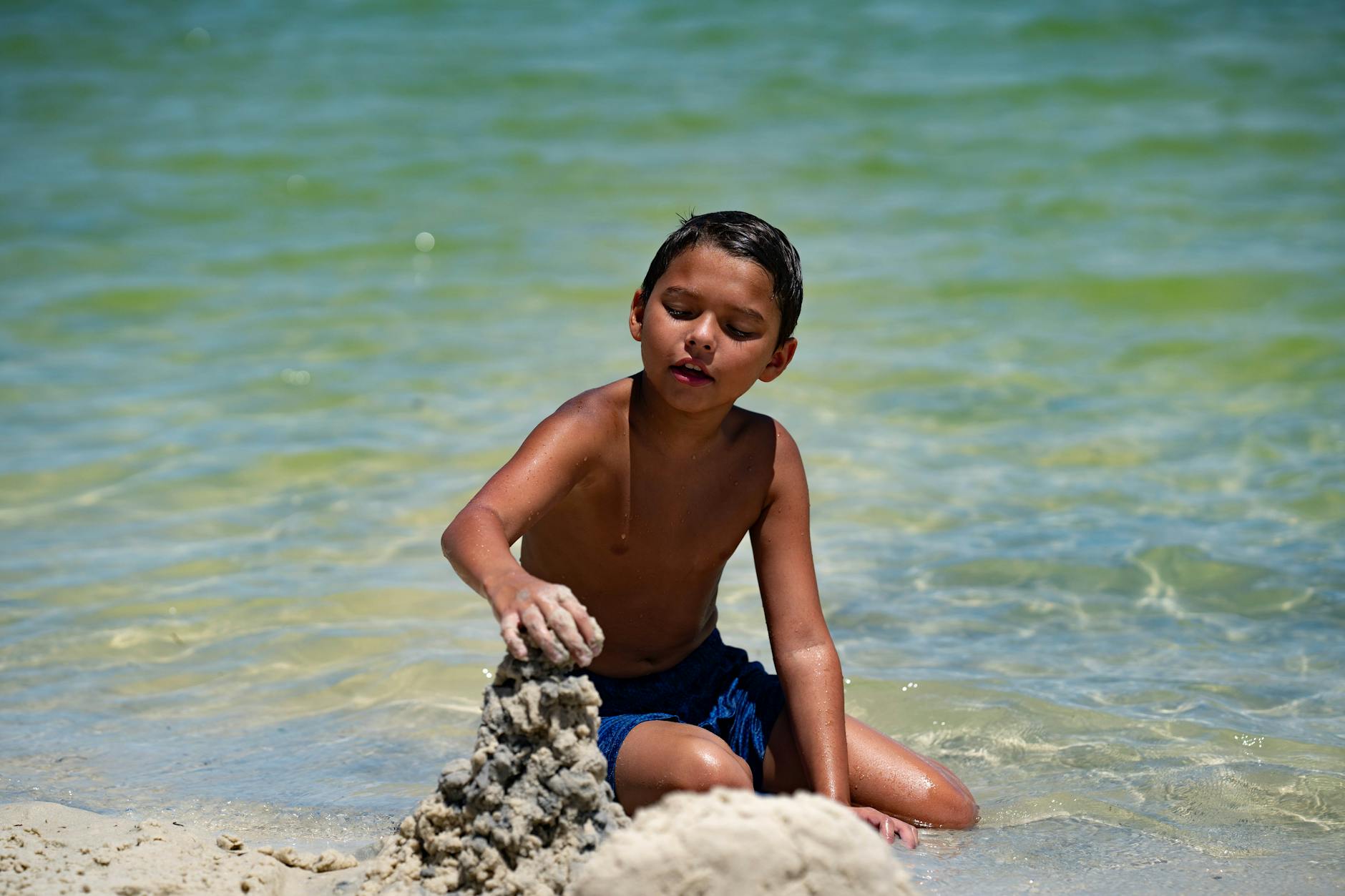
Wave patterns and water movement. Watch the waves. Talk about what makes them. Dig a channel in the wet sand and watch how water fills it. Build a small berm and see how long it holds. This is physics. It’s also just deeply satisfying for kids who love to dig, which is every kid I’ve ever met.
For more ideas like these, I have a whole post on easy outdoor science experiments for kids in the backyard — a lot of those concepts translate beautifully to the beach too.
Art and Language Arts
Beach nature journaling. I already mentioned the journals, but I want to say it again because it’s that good. There’s something about the combination of fresh air, real subject matter, and a blank page that unlocks creativity in kids who otherwise resist writing. My daughter has filled more pages at the beach than anywhere else. Have them write one observation sentence, sketch one thing they found, and label it. That’s it. That’s a complete Charlotte Mason nature study lesson.
Storytelling walks. On the drive home or during a shady break, ask your kids to tell you the story of one creature they saw. Where did it come from? What did it eat today? What’s it afraid of? This is oral narration — another Charlotte Mason cornerstone — dressed up as play.
Life Skills and Character
Leave No Trace practice. We always do a quick scan before we leave — pick up any trash we brought, make sure we haven’t disturbed any nesting areas, put back anything we moved. This is environmental stewardship in action, not as a lecture but as a habit.
Real responsibility. Let kids carry their own gear, keep track of their nature journal, manage their water bottle. It sounds small, but it’s part of raising capable, self-sufficient kids. The same way our kids have real chores with the chickens at home, they have real roles on a beach day.
Making It Count for Your Homeschool Records
If you’re on the Florida PEP scholarship like we are, you already know that documentation matters. Beach days absolutely count — log them under science (marine biology, earth science), nature study, or physical education. Take a few photos, have kids narrate what they learned, and jot down a sentence or two about what you covered. Done. It’s a legitimate school day, and honestly one of the best ones you’ll have all year.
And if you’re looking for more ideas for getting outside with your kids in our Florida climate, check out outdoor activities for kids in Florida’s winter months — because yes, our “winter” beach days are some of our absolute favorites.
One Last Thing
I grew up in the ’90s making up games in the yard, catching critters, and spending whole summers without a structured plan — and I turned out just fine. More than fine, honestly. I think about that a lot when I’m tempted to over-engineer our beach days. The beach already has everything. The sand, the water, the birds, the weird little creatures — it’s all there. Our job is mostly just to show up, put the phones away, and let them discover.
That’s the whole thing, really. Show up. Notice together. Go home sandy and tired and full.
That’s a good school day.
📖 You Might Also Like:
- Natural Remedies for Kids’ Common Colds: What Actually Works (From a Real Mama Who’s Tried It All)
- Wondercide Honest Review: Is It Actually Safe and Effective for Families with Kids, Pets, and Chickens?
- Outdoor Activities for Kids in Florida’s Winter Months (What We Actually Do When the Weather Finally Cooperates)
Frequently Asked Questions
What are the best educational beach activities for elementary-age kids in Florida?
Some of the best options include shell identification and sorting, shorebird watching with a field guide, tide pool exploration, sand observation with a pocket microscope, and nature journaling with watercolors. These activities build real science and observation skills without feeling like structured school.
Can a beach field trip count toward our Florida homeschool PEP scholarship requirements?
Yes! Beach days can absolutely be documented as school time. Log them under science (marine biology, earth science, ecology), nature study, or physical education. Take photos, have kids do a short oral or written narration of what they observed, and note what topics you covered. It’s a legitimate and valuable school day.
What should I bring to the beach for a Charlotte Mason nature study day?
A nature journal and pencils, watercolor paints, a pocket microscope, a field guide (like Sibley’s for birds), a bug catcher for observing tide pool creatures, non-toxic sunscreen, and reusable water bottles. You really don’t need much — the beach provides the curriculum.
What’s the best time of year to do educational beach activities with kids in Florida?
Honestly, any time — but Florida’s fall and winter months (October through March) are especially wonderful because the weather is mild, the beaches are less crowded, and shorebird populations are at their peak during migration season. Summer works too, but plan for early mornings before the heat peaks.
How do I turn a regular beach trip into a nature study lesson without it feeling forced?
Keep it simple and follow your child’s curiosity. Bring a journal and field guide, but don’t force a structure. Ask open-ended questions like ‘What do you notice?’ or ‘I wonder why that bird keeps doing that?’ Let them collect, sort, sketch, or just dig — observation naturally follows when kids are in a rich environment and given the space to explore.
Leave a Reply