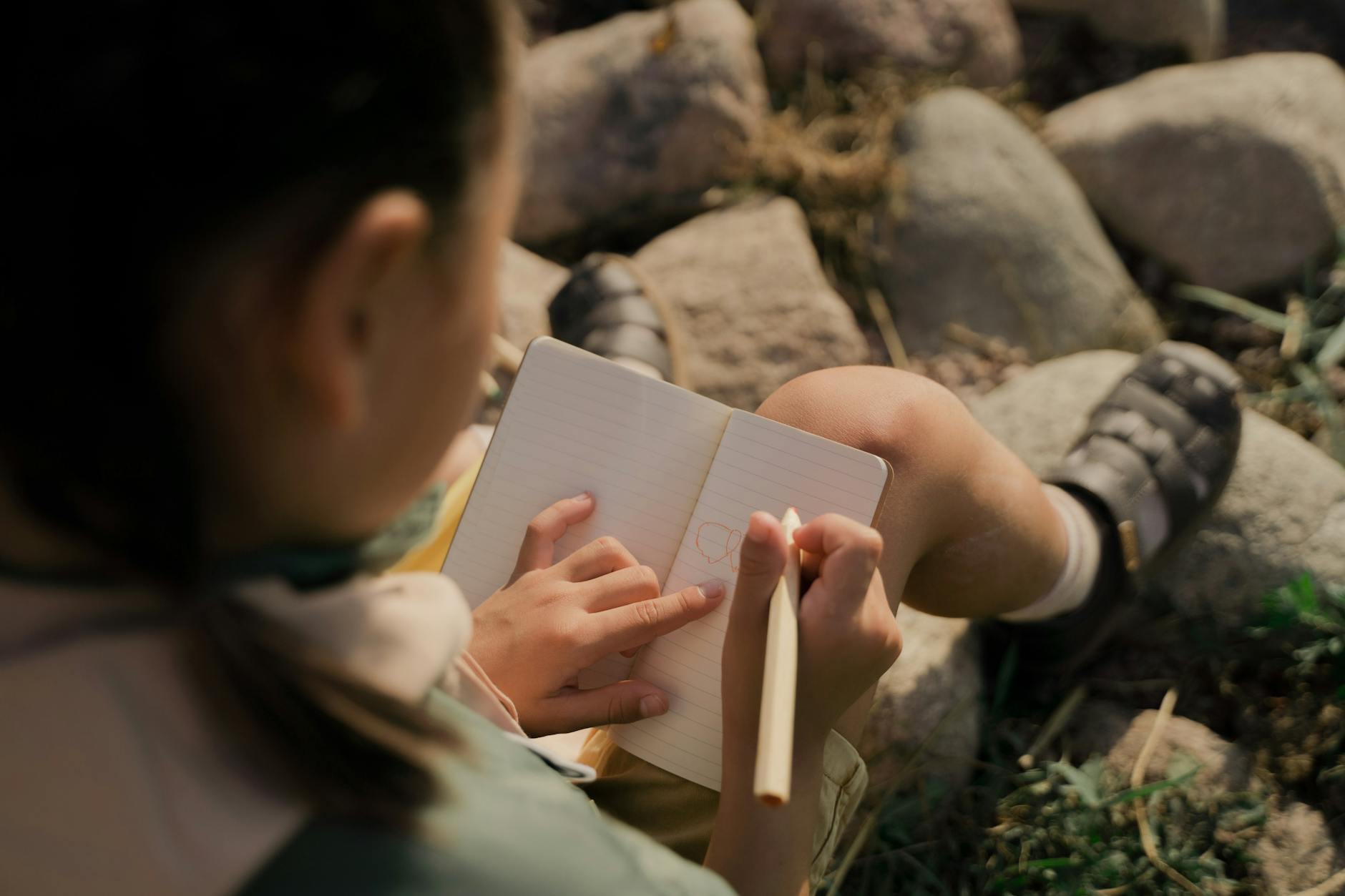
How to Start Nature Journaling with Kids: A Beginner’s Guide for Families Who Love the Outdoors
This post contains affiliate links. I may earn a small commission at no extra cost to you.
I’ll be honest with you — the first time I handed my daughter a blank journal and said “draw what you see,” she stared at me like I’d asked her to solve a calculus problem. She wanted me to tell her what to draw, how to draw it, and whether it would be graded. And I get it. We’ve accidentally trained kids to expect instructions for everything.
But that’s kind of the whole point of nature journaling. It’s one of those beautiful, low-stakes practices that quietly teaches kids to slow down and actually look at the world around them. And here in Northwest Florida, y’all — we have so much world to look at. Gopher tortoises ambling through the yard, osprey diving over the bay, love bugs (bless), Gulf fritillary butterflies on the passionflower vine, our hens scratching around in the pine straw. There is never a shortage of things to notice.
If you’ve been curious about starting nature journals with your kids but felt overwhelmed or unsure where to begin, this is for you. Let’s keep it simple.
What Is Nature Journaling, Really?
Nature journaling is just the practice of recording what you observe in the natural world — through drawing, writing, painting, or some combination of all three. It’s rooted deeply in the Charlotte Mason approach to education, which holds that children learn best through firsthand experience with real things, not just textbook descriptions of them.
Charlotte Mason herself called it “nature notebooking,” and it was a cornerstone of her method. The goal isn’t to produce beautiful artwork (though that happens). The goal is to build the habit of observation — to train a child’s eyes to actually see what’s in front of them.
If you want to read more about how we structure our days around this kind of learning, I shared our whole rhythm over in our Charlotte Mason Daily Schedule for Elementary Ages: What Actually Works for Our Family.
What Supplies Do You Actually Need?
Here’s the good news: not much. Don’t let the gorgeous Instagram nature journals intimidate you. We started with a blank notebook and some colored pencils, and that was plenty.
Here’s what we actually use and love:
A Good Blank Journal
We use a simple nature journal with unlined pages — this is key. Lined pages make kids feel like they have to write, and for little ones especially, the freedom of a blank page is everything. Each kid has their own. They decorate the covers. They feel ownership over it.
Something to Draw With
We started with just regular colored pencils. Now we’ve added Faber-Castell watercolor pencils, which are a total game-changer for nature journaling because you can sketch dry and then sweep a wet brush over it to create that soft, painterly look. My kids think it feels like magic. They’re not wrong.
A Field Guide
Once your kids start noticing birds (and they will), a field guide becomes essential. We keep the Sibley Birds guide on our nature shelf. Even my kindergartner loves flipping through it trying to match what she saw at the feeder.
A Pocket Microscope (Optional but SO Fun)
If your kids are into bugs and tiny things — and most elementary-age kids really are — a pocket microscope adds a whole layer of wonder. We’ve examined feathers from our hens, moth wings, and lichen from the live oak out front. Kids lose their minds.
How to Actually Start (Without Overthinking It)
Step 1: Go Outside With No Agenda
This is the hardest step for rule-following, curriculum-loving homeschool mamas (hi, it me). Resist the urge to assign a subject. Just go outside with your journals and say, “Find something interesting and draw it.”
In Florida, this works year-round. Even January mornings here are gorgeous — cool, low-humidity, birds everywhere. Grab a kids’ bug catcher kit and let them capture something for a few minutes of close observation before releasing it.
Step 2: Model It Yourself
Sit down and journal alongside them. Kids mirror what they see, not what they’re told. If you’re sketching that spider lily growing by the fence, your kid is going to want to sketch it too. You don’t have to be a good artist. You just have to be doing it.
Step 3: Ask Observation Questions, Not Knowledge Questions
Instead of “What kind of butterfly is that?” try:
- “How many colors do you see on its wings?”
- “What shape are the edges — smooth or jagged?”
- “Does it stay still or keep moving?”
This builds the habit of looking before labeling, which is the whole point.
Step 4: Add Words Gradually
For young kids, a drawing is enough. Totally enough. As they get more comfortable, encourage them to add a label, a date, the weather, or one sentence about what they noticed. My third grader now writes little observation paragraphs without being asked. That did not happen overnight — it grew slowly, journal entry by journal entry.
Step 5: Make It a Regular Thing
We do nature journaling as part of our morning basket time a few days a week, and then more spontaneously when something catches our attention — a hawk in the yard, a weird mushroom after rain, the chickens doing something funny. If you want to see how this fits into a larger rhythm, peek at our Charlotte Mason Morning Basket Ideas for Beginners post.
Florida-Specific Things Worth Journaling
Living here in the Panhandle gives us a genuinely incredible nature classroom. Some things we’ve journaled that you might love too:
- Backyard chickens — feather comparisons, egg sketches, behavioral observations. Honestly, our chickens have been one of the richest nature study subjects we have. If you’re thinking about starting a flock and want a great resource for the kids, Storey’s Guide to Raising Chickens and A Kid’s Guide to Keeping Chickens are both wonderful.
- Gulf Coast shorebirds — we take our journals to the beach and it’s honestly one of our favorite homeschool field trips
- Longleaf pine ecosystems — the Florida state forests are magical and underrated
- Seasonal wildflowers — coral honeysuckle, swamp rose mallow, black-eyed Susans
- Weather and sky — Florida skies are dramatic and kids love sketching clouds and recording the daily thunderstorm season
For more outdoor adventure ideas, our Florida State Parks Free Homeschool Field Trip Ideas post has a ton of good spots.
A Word About Pressure (and Perfection)
Nature journals are not graded. They’re not portfolios (well, they can go in your portfolio, but that’s not their purpose). They are living records of a child paying attention to the world. Torn pages, wobbly drawings, misspelled labels — all of it belongs.
This is very much a 1990s-childhood kind of thing. Go outside. Look at stuff. Write it down. There’s no app for it, no achievement badge, no one watching. It’s just a kid and a creek and a pencil.
And honestly? Those are some of the richest learning moments we have in our whole homeschool.
If you’re just getting started and feeling unsure, please don’t wait until you have the perfect supplies or the perfect plan. Grab a blank notebook, head to the backyard, and just start. The practice grows on its own once you give it a little room. Our family has filled multiple journals now, and flipping back through them is one of my favorite things — little drawings of frog eggs and chicken feathers and mystery mushrooms, all dated, all real. That’s your kid’s childhood, captured on paper.
You’ve got this, mama.
📖 You Might Also Like:
- Florida PEP Scholarship Approved Vendors List 2026: What Homeschool Families Actually Need to Know
- Florida PEP Scholarship vs Hope Scholarship: Which One Is Right for Your Homeschool Family?
- Backyard Chickens First Egg: What to Expect When Your Hens Start Laying
Frequently Asked Questions
What age can kids start nature journaling?
Kids can start nature journaling as young as 3 or 4 — at that age it looks mostly like scribbling and free drawing, which is perfectly fine. For elementary-age kids (K-5), nature journaling is a great fit. The key is keeping it low-pressure and letting the drawing lead, with writing added gradually as kids grow more comfortable.
Does a nature journal have to include writing, or can it just be drawings?
Drawings alone are completely valid — especially for younger kids. A nature journal entry can be just a sketch with a date on it and that counts. Writing like labels, descriptions, or observation notes can be added gradually as kids get older and more confident. The goal is observation, not literary output.
How often should we do nature journaling?
There’s no magic number. Even once a week is enough to build the habit. Many Charlotte Mason families aim for a few times a week during nature study or morning basket time, plus spontaneous entries whenever something interesting shows up — a cool bug, a new bird at the feeder, something blooming in the yard. Consistency matters more than frequency.
What supplies do I need to start a nature journal with my kids?
You really just need a blank (unlined) notebook and something to draw with — colored pencils work great to start. As you grow into the practice, watercolor pencils, a field guide for your region, and a simple magnifying tool like a pocket microscope add a lot of richness without a big investment.
Is nature journaling part of the Charlotte Mason method?
Yes — Charlotte Mason called it ‘nature notebooking’ and considered it a core part of her educational philosophy. She believed children should spend significant time outdoors observing the natural world firsthand, and the nature journal was the tool for recording and deepening those observations. It supports narration, attention, and a lifelong love of the natural world.
Leave a Reply